
_edited.png)
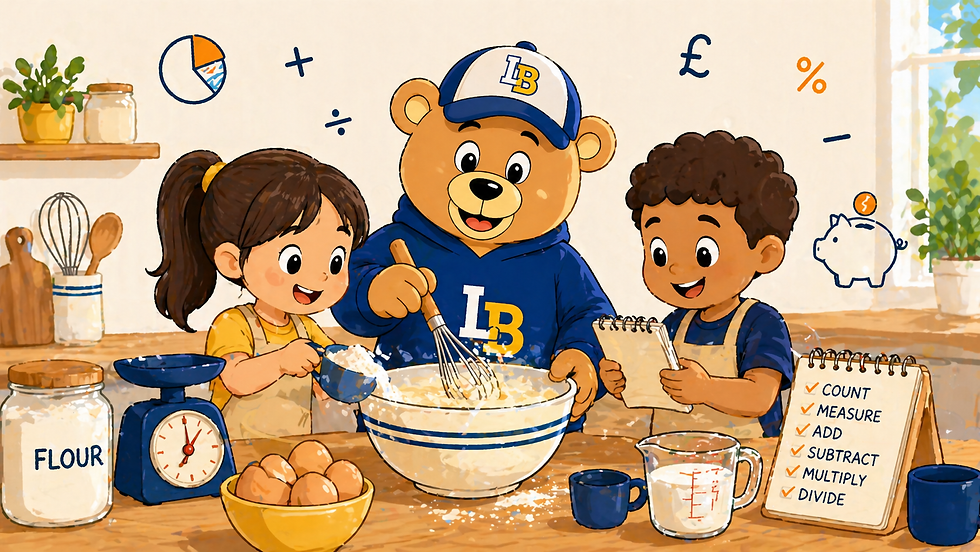
Teach Children About Money Using Food and Baking
As parents, we want our children to grow up confident, capable and prepared for real life. One of the most important, yet often overlooked is life skills is understanding money.
Children begin forming their attitudes towards money from a very young age, so the way we introduce it matters. The good news is that teaching kids about money does not have to feel complicated or boring.
Children learn best through real-life experiences. Using everyday activities like food and baking makes money concepts easier to understand because children can see, touch and take part in the process. Helping children understand money early builds confidence, independence and better decision-making as they grow.
These are the kinds of real-world learning experiences we encourage through Little Bosses Academy, helping children build confidence with money in a way that feels natural and engaging.

TEACH CHILDREN BUDGETING THROUGH EVERYDAY FOOD CHOICES:
Helping children understand budgeting is a practical life skill that puts them in control of their money, both now and in the future.
Food-based activity:
Talk to your child about the family’s weekly food budget and involve them in making a shopping list. Tell them the spending limit for your shopping trip and explain what needs to be bought before you go.
While shopping, talk to your child about why you have made certain food choices to keep within budget — for example avoiding impulse buys, choosing supermarket brands instead of big brands, or making simple substitutes. You can also involve them in comparing prices as you go.
This is a good opportunity for your child to use real money if you decide to pay by cash. In a digital world, it is important to embrace the tools that help us manage money, but also to give children the chance to see and handle money so they understand its value.
These small, everyday moments are often the most effective way of teaching children about budgeting and money in a way that feels real.

TEACH PROFIT & LOSS
Teaching children profit and loss helps them understand how people gain or lose money. This is also a great way for children to practice their maths skills; adding, subtracting, multiplying and dividing.
Food-based activity:
Set up a pretend bakery, café or food stall at home and involve your child in the whole process. Talk through how much the ingredients cost and work out the total together.
Then ask your child to decide how much they would charge for what they have made. This is a great opportunity to introduce simple ideas like cost price, selling price, profit and loss in a way that feels natural and easy to understand.
Baking works particularly well for this because children can clearly see the process from start to finish, from buying ingredients to creating something they can sell or share.
Experiences like this can also be seen in real-life settings such as Barry’s Bakehouse, where baking becomes a practical way for children to explore money, teamwork and decision-making.

TEACH ABOUT SAVING
Saving is a tool that empowers children to be financially free. It also teaches children that they can set goals and achieve them. Furthermore, teaching children how to save, develops their decision making skills.
Saving should be a fun. Remember that the ability to delay gratification can be learnt, so set age-appropriate challenges.
Food-based activity:
Ask your child to choose a special friend or family member they would like to make a birthday cake for.
Support them in working out a simple budget for the cake, including the cost of ingredients, and talk about how long it might take to save that amount.
Agree on an amount they will save from their pocket money each week. This can also be a great opportunity for older children to practise fractions as they decide how much to set aside.
Remember to celebrate each saving milestone along the way to help keep them motivated.

TEACH ABOUT PLANNING
Teaching children about forward planning develops their organisational skills and the ability to manage what they have to reach their goal. This life-skill can be built during childhood.
Food-based activity:
Set some time aside to plan a week’s meals with your child. Engage them in writing out the ingredients needed for the week and checking what you already have at home.
Talk to your child about how leftover food can be properly stored to avoid waste and save money. This is a good opportunity to introduce the idea of planning for a rainy day and, through discussion, help them understand why it is important to set money aside for both now and the future, as things may not always go as planned.
Discuss simple ways that leftovers can be used up and how this helps save money. For example, leftover mashed potatoes can be used to make bubble and squeak.
For older children, you could take this a step further by comparing the cost of a takeaway version of the meal and working out how much money has been saved.

TEACH ABOUT THE POWER OF COMPOUNDING
Compound interest is earning interest on your savings, and also, eventually, on the interest that those savings earn. Teaching children about compound interest develops patience and delayed gratification.
Food-based activity:
Give your child one marshmallow. Explain that if they can resist eating it for 10 minutes, they will receive another.
Then challenge them again; if they can wait a further 10 minutes without eating the two marshmallows, they will be rewarded with two more.
By the end of the activity, they will have four marshmallows after 20 minutes.
Afterwards, guide your child to reflect on what happened; the longer they waited, the more they gained. This introduces the idea of delayed gratification in a simple, visual way.
You can then relate this to money by explaining that when we leave money in savings over time, it can grow and the longer it is left, the more it can increase. This is the basic idea behind how compound interest works.
Why food and baking are powerful ways to teach children about money
Food and baking naturally bring together a range of important life skills.
Through simple, everyday activities, children learn to:
count and measure
plan ahead
make decisions
understand value
solve problems
Because the experience is hands-on, the learning feels real and that is what helps it stay with them.
Final thoughts
Teaching children about money does not need to be complicated. When learning is part of everyday life, children are far more likely to understand it and feel confident using it.
Food and baking offer a simple and practical way to introduce budgeting, saving and decision-making — skills that will support children as they grow.
If your child enjoys learning in this hands-on way, you can explore more real-life experiences through Little Bosses Academy, where children build confidence with money through practical, everyday activities.
If you would like to see how these skills can come to life in a real setting, experiences like Barry’s Bakehouse offer children the opportunity to explore baking, teamwork and decision-making in practice.
Comments