
_edited.png)
What Does It Really Mean to be Ready for the Real World?

"Is your child ready for the real world?"
It is a question that appears simple on the surface, yet the more I think about it, the more complicated it becomes.
For many years, readiness was often associated with academic achievement. If a child worked hard, achieved good grades and progressed successfully through school, we assumed they were being prepared for the future. Academic learning remains incredibly important, of course, but I have increasingly found myself wondering whether it tells the whole story.
The reality is that the world our children are growing into will demand far more than subject knowledge alone. It will require them to navigate uncertainty, solve unfamiliar problems, collaborate with people from different backgrounds, adapt to change and make decisions in situations where there is no obvious right answer. In many ways, the future will place a premium on qualities that are much harder to measure than attainment levels or test scores.
This is often where my conversations with parents begin to shift. Rarely do parents sit across from me and say, "I'm worried about my child's arithmetic." More often, they talk about what happens when things become difficult. They describe a child who gives up quickly when faced with a challenge, or one who has brilliant ideas but hesitates to share them. They talk about children who struggle when plans change unexpectedly, children who avoid responsibility, or children who seem capable of far more than they currently believe.
What strikes me about these conversations is that parents are rarely talking about knowledge. They are talking about how their child responds to life.
The more time I have spent working with children, the more convinced I have become that these responses matter enormously. Childhood is not simply a period during which knowledge is accumulated; it is a period during which patterns of thinking, behaving and responding to the world are formed. The habits and beliefs children develop about themselves influence how they approach challenge, how they interact with others and how they engage with opportunities long before they enter adulthood. In many ways, they reveal whether we are genuinely preparing children for the real world or simply helping them succeed within a particular educational system.
Preparing Children for the Real World Requires More Than Academic Success

Educational psychology has long highlighted the importance of these underlying capacities. Two children with similar levels of ability can respond very differently to the same situation. One may view a challenge as something to work through, whilst another may see it as evidence that they are incapable. One may approach uncertainty with curiosity, whilst another retreats from it.
One may recover quickly from disappointment, whilst another becomes stuck. In many cases, the difference is not intelligence. It is the collection of developmental capacities sitting beneath performance.
This became increasingly apparent to me through my work at Little Bosses Academy. Whilst children may appear to be learning about enterprise, leadership or communication, what interests me most is often what is happening beneath the surface. The business activity is visible. The developmental process is not. It was here that I began to think more deeply about what preparing children for the real world actually looks like in practice.
When a child continues refining an idea after it has failed several times, something important is taking place. When a child presents to a group despite feeling nervous, something important is taking place. When a child adapts a plan that is no longer working, manages a disagreement within a team or takes responsibility for a mistake, something important is taking place.
Over time, I began to notice recurring patterns in these moments. The children who flourished were not necessarily the most academically advanced, nor were they always the loudest or most naturally confident. Instead, they demonstrated a collection of capacities that seemed to influence how they engaged with challenge and opportunity.
They believed they could learn and improve.
They thought independently rather than waiting for someone else to provide the answer.
They managed emotions in a way that allowed them to move forward after setbacks.
They were willing to contribute, participate and try.
They adapted when circumstances changed.
They took ownership of their actions.
They persisted when things became difficult.
The more I observed these patterns, the clearer it became that they were not isolated traits. They were interconnected capacities that worked together to shape how children experienced learning, relationships, leadership and growth.
Why the STEWARD Process Underpins Our Work
The more I reflected on these experiences, the more I realised that preparing children for the real world involves developing capacities that are often hidden beneath visible achievement.
Those observations eventually evolved into what we now call the S.T.E.W.A.R.D Process.
The S.T.E.W.A.R.D Process is not a programme that sits alongside our work; it is the developmental thinking that sits beneath it. It helps us understand what children are really learning when they create a product, solve a problem, lead a team or present an idea. Whilst the visible outcome may be a business project, the deeper outcome is often the development of Self-efficacy, Thinking skills (Executive), Emotional intelligence, Willingness (to act) , Adaptability, Responsibility and Drive.
This is what makes the S.T.E.W.A.R.D Process so important to our approach. It reminds us that the goal is not simply to help children complete activities successfully. The goal is to create experiences that develop the capacities children will draw upon throughout their lives.
Readiness for the real world, therefore, is about far more than what a child knows. It is about how they respond when they do not know. It is about how they handle uncertainty, challenge, responsibility and change. It is about the habits, beliefs and dispositions that shape the choices they make and the opportunities they are willing to pursue.
For us, preparing children for the real world is not about predicting every challenge our children may face. It is about helping them develop the confidence, judgement and adaptability to navigate those challenges when they arrive.
Perhaps that is why I continue returning to the same question.
Not, "What does this child know?"
But, "Who is this child becoming?"
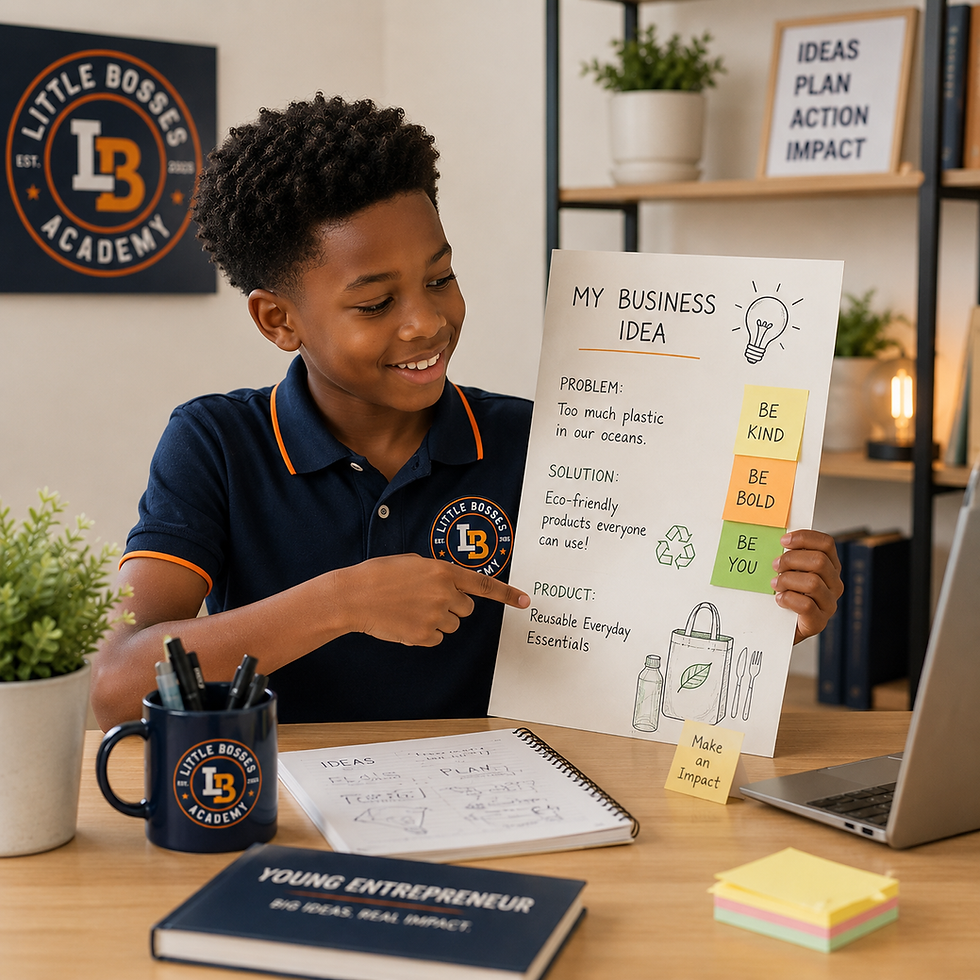
For us at Little Bosses Academy, the S.T.E.W.A.R.D Process provides a practical answer to that question. It underpins every challenge we design, every experience we facilitate and every opportunity we create because we believe that developing capable young people begins long before adulthood arrives.
The businesses children build matter.
The projects they complete matter.
The presentations they deliver matter.
Yet what matters most is the person they are becoming through the process.
Continue the Conversation
As you reflect on your own child, consider the qualities that sit beneath achievement.
How do they respond when something feels difficult?
How do they handle disappointment?
Do they think independently, adapt when circumstances change and persevere when the answer is not immediately obvious?
These are the questions that shape the S.T.E.W.A.R.D Process and the questions that shape our work at Little Bosses Academy.
If this article has sparked a new perspective on your child's development, I would love to hear your thoughts. To learn more about the S.T.E.W.A.R.D Process and our upcoming programmes, get in touch with the Little Bosses Academy team.
Because preparing children for the future is not simply about helping them know more.
It is about helping them become more.
Explore our programmes | Learn about the S.T.E.W.A.R.D Process | Contact Us


Comments